

For this weeks blog I am exploring the very interesting genre of ragtime, which not many people associate with the banjo. When one thinks of ragtime what immediately comes to mind is Scot Joplin, The Sting (for you movie buffs), Snooker (for your old sport buffs) and an old timer playing the piano in a grubby Salon waiting for the next fist fight to break out (for you western buffs). But not the Banjo. Lets see how this wonderful genre of music translates to the banjo with the Beaumont Rag
Analysis
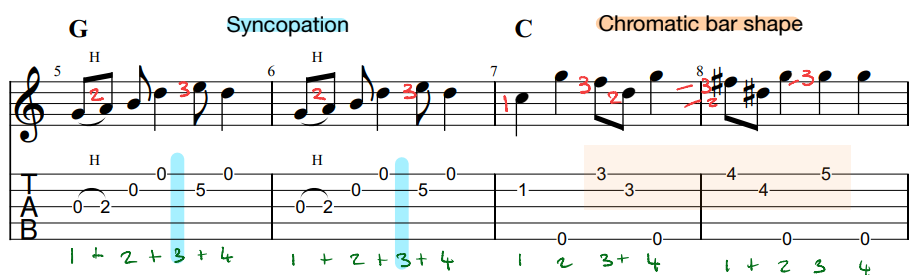
A key feature of ragtime is syncopation, which is a fancy way of saying the melody moves from the main beat and is transferred to the off beats. This can be seen in the diagram below. The melody in bars 5 and 6 comes from the forward roll to miss the 3rd beat (highlighted in blue), moving the emphasis to the off beats and creating a swing rhythm. Also noted is the chromatic movement which follows in bars 7 and 8. This is another defining feature of ragtime music, demonstrated here by the bar shape moving chromatically from the 3rd to the 5th fret:
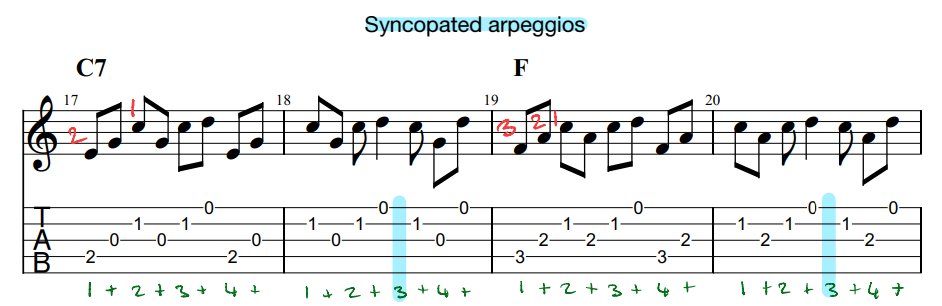
In the more advanced version of the Beaumont rag syncopation occurs using arpeggiations of the C7 and F chords. By holding the chord shapes and using a pattern of inside and outside forward rolls syncopation occurs naturally by missing the 3rd beat (in blue):
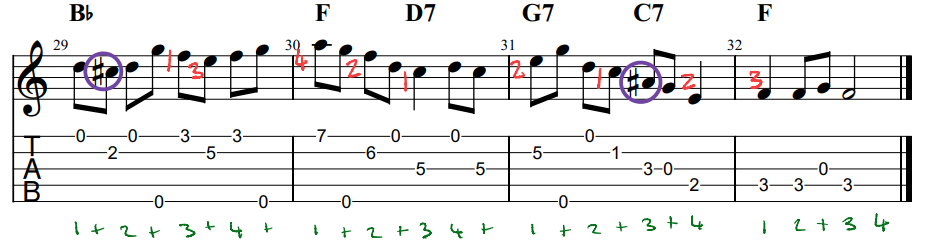
The use of accidentals (circled in purple) to create a chromatic melody that slithers up and down the scale can also be seen near the end of the advanced version:
Musical effects such as syncopation and chromaticism can be easily incorporated into roll and scale patterns on the bajo to create an effective ragtime sound. Because of this I think it is a misconception to state that the banjo can only play bluegrass music, and indeed exploring genres such as this can only increase the musical experience, knowledge and ability of the player. I know my pupils are enjoying currently playing this piece and I hope it will provide inspiration for other banjo players
The full audio versions of the Beaumont rag are provide below, beginning with the standard and then advanced version: